Sublime text для windows 7
Содержание:
- Скачивание и установка
- Inheritance 4075
- Scope Rules
- Some features our users love:
- Активация Sublime Text 3
- Project Format
- Преимущества и недостатки Sublime Text
- Installation
- Colors
- Including Other Files
- Selected Examples
- Installation
- Using the External Libraries
- Configuring
- sublime_plugin.ViewEventListener Class
- Adding custom Emmet snippets
- Troubleshooting
- Plugin Support
- The Team Behind Sublime Merge
- Feedback
- Thank You
- Caveat 2: Windows
- Selected Examples
Скачивание и установка
Рассмотрим самую последнюю версию Sublime Text 3, поэтому наша инструкция может отличаться от того что вы видели ранее в интернете.
Чтобы скачать Sublime Text 3 откройте сайт sublimetext.com/3. Откроется страница — Download Sublime Text 3. Здесь вы можете выбрать необходимую версию под вашу операционную систему. Выбираю для windows Sublime Text 3 64 bit. Если у вас тоже windows 64 bit, можете выбрать соответствующий файл Sublime Text или его портативную версию. Скачайте загрузчик. После того как загрузчик будет скачан можно приступить к установке.

Рассмотрим как установить Sublime Text 3.
Запускаем скачанный файл от имени администратора.

Подтверждаем установку Sublime Text.


Выбираем путь для установки или оставляем тот, что выбрала программа по умолчанию.

На следующем шаге Sublime Text предложит добавить себя в контекстное меню. Отметьте галочку, чтобы разрешить это.

Далее устанавливаем и финишируем установку.


Установленный Sublime Text вы можете найти через меню “Пуск” — “Все программы”.


Inheritance 4075
In situations where a syntax is a slight variant of another, with some additions or changes, inheritance is a useful tool.
When inheriting a syntax, the key extends is used with a value containing the packages path to the parent syntax. The packages path will start with Packages/ and will contain the package name and syntax filename. For example:
A syntax using inheritance will inherit the variables and contexts values from its parent syntax. All other top-level keys, such as file_extensions and scope will not be inherited.
Variables
When extending a syntax, the variables key is merged with the parent syntax. Variables with the same name will override previous values.
Variable substitution is performed after all variable values have been realized. Thus, an extending syntax may change a variable from a parent syntax, and all usage of the variable in the parent contexts will use the overridden value.
Contexts
The contexts in an extending syntax will be a combination of the contexts from the parent syntax, and all those defined under the contexts key.
Contexts with the same name will override contexts from the parent syntax. To change the behavior when a context name is duplicated, two options are available. These meta key must be specified in the extending syntax:
-
all of the patterns in the extending syntax will be inserted before those in the parent syntax.
-
all of the patterns in the extending syntax will be inserted after those in the parent syntax.
Scope Rules
Color schemes interact with the text in a file via scopes. Scopes are set
to code or prose tokens via the syntax. Scopes are dotted strings,
specified from least-to-most specific. For example, the
keyword in PHP could be specified via the scope name
.
Matching
Color schemes apply colors and font styles to the scopes by matching the
dotted labels, starting with the first. Prefix matching is the standard
way to have a color scheme apply to multiple syntaxes. Instead of matching
, most color schemes will instead assign
a color to . Matching the first one or two labels
in a scope is most common. Including the final label, the syntax name, is
uncommon unless a syntax-specific override is desired.
Naming
Author of syntaxes can assign whatever scopes they want to a given token.
This combined with the fact that there are hundreds of community-maintained
syntaxes means that is can be hard to know what scopes to target. The
official Scope
Naming guidelines were established to help syntax and color scheme
authors use a common set, for better interoperability. The
section provides a baseline set of scopes that color
scheme authors should strive to handle.
Style Rules
Each scope style rule consists of an object containing a
key, along with one or more of the following optional keys:
- – the (arbitrary) name for the scope rule
- – the text color
- – the background color
- – adjustment to the color, only valid with
- – the text color when selected
- – zero or more of , , separated by spaces
The key accepts a space-separated
list of adjusters that are supported by the
. It is only supported when the
key is also specified, and thus allows
modifying all foregrounds used in combination with the background,
without having to create different rules for every permutation.
Hashed Syntax Highlighting
The key supports a special mode called
Hashed Syntax Highlighting, where each token matching the scope
specified will receive a unique color from one, or more, gradients.
Some editors refer to this style of highlighting as
«Semantic Highlighting».
To use Hashed Syntax Highlighting, the key
must have a value that is a list of two or more colors. Sublime Text
will create 256 different colors that are linear interpolations
(lerp) between the colors provided. The interpolation is done in
HSL space.
As Sublime Text highlights the tokens in a file, it will create a
hashed value of the token, and use that to pick one of the 256
linear interpolations. Every instance of a given token will use the
same color. For instance, each instance of
would have the same color, but every instance of
would have a different color.
For Hashed Syntax Highlighting to be most obvious, the hue
difference between the start and end points should be as far apart
as possible. Here is an example of using blues, purples and pinks
for variable names:
Some features our users love:
Goto Anything
Use Goto Anything to open files with only a few keystrokes, and instantly jump to symbols, lines or words.
Triggered with Ctrl+P⌘+P, it is possible to:
- Type part of a file name to open it.
- Type @ to jump to symbols, # to search within the file, and to go to a line number.
These shortcuts can be combined, so tp@rf may take you to a function read_file within a file text_parser.py. Similarly, tp:100 would take you to line 100 of the same file.
Goto Definition
Using information from syntax definitions, Sublime Text automatically generates a project-wide index of every class, method and function. This index powers Goto Definition, which is exposed in three different ways:
- A popup is displayed when hovering over a symbol
- Pressing F12 when the caret is on a symbol
- The Goto Symbol in Project functionality
Symbol indexing can be customized on a per-syntax basis via configuration files, allowing users to tailor the feature to their needs.
Multiple Selections
Make ten changes at the same time, not one change ten times. Multiple selections allow you to interactively change many lines at once, rename variables with ease, and manipulate files faster than ever.
Try pressing Ctrl+Shift+L⇧+⌘+L to split the selection into lines and Ctrl+D⌘+D to select the next occurrence of the selected word. To make multiple selections with the mouse, take a look at the Column Selection documentation.
Command Palette
The Command Palette holds infrequently used functionality, like sorting, changing the syntax and changing the indentation settings. With just a few keystrokes, you can search for what you want, without ever having to navigate through the menus or remember obscure key bindings.
Show the Command Palette with Ctrl+Shift+P⇧+⌘+P.
Powerful API and Package Ecosystem
Sublime Text has a powerful, Python API that allows plugins to augment built-in functionality.
Package Control can be installed via the command palette, providing simple access to thousands of packages built by the community.
Customize Anything
Key bindings, menus, snippets, macros, completions and more — just about everything in Sublime Text is customizable with simple JSON files. This system gives you flexibility as settings can be specified on a per-file type and per-project basis.
Split Editing
Get the most out of your wide screen monitor with split editing support. Edit files side by side, or edit two locations in the one file. You can edit with as many rows and columns as you wish. Take advantage of multiple monitors by editing with multiple windows, and using multiple splits in each window.
Take a look at the View Layout menu for split editing options. To open multiple views into the one file, use the File New View into File menu item.
Instant Project Switch
Projects in Sublime Text capture the full contents of the workspace, including modified and unsaved files. You can switch between projects in a manner similar to Goto Anything, and the switch is instant, with no save prompts — all your modifications will be restored next time the project is opened.
Performance
Sublime Text is built from custom components, providing for unmatched responsiveness. From a powerful, custom cross-platform UI toolkit, to an unmatched syntax highlighting engine, Sublime Text sets the bar for performance.
Активация Sublime Text 3
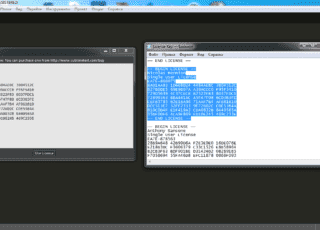
Чтобы активировать Сублайн текст 3 откройте текстовый документ License Key, скопируйте из него один из ключей, далее запустите Сублайн и перейдите во вкладку «Справка» («Help«) — «Ввести лицензию» («Enter license«) вставляем ключ и жмем «Use License»

Установка Emmet на sublime text 3 и добавление в него Package Control.
Запускаем редактор и нажимаем Ctrl+ или «Вид» — «Показать/скрыть консоль» («View» — «Show console«), после чего снизу откроется панелька для ввода, вставьте в нее нижеприведенный код, нажмите «Enter«, немного подождите и перезапустите редактор.
import urllib.request,os,hashlib; h = 'df21e130d211cfc94d9b0905775a7c0f' + '1e3d39e33b79698005270310898eea76'; pf = 'Package Control.sublime-package'; ipp = sublime.installed_packages_path(); urllib.request.install_opener( urllib.request.build_opener( urllib.request.ProxyHandler()) ); by = urllib.request.urlopen( 'http://packagecontrol.io/' + pf.replace(' ', '%20')).read(); dh = hashlib.sha256(by).hexdigest(); print('Error validating download (got %s instead of %s), please try manual install' % (dh, h)) if dh != h else open(os.path.join( ipp, pf), 'wb' ).write(by)

Теперь заходим во вкладку «Опции» — «Package Control» или нажимаем сочетание клавиш «Ctrl» + «Shift» + «P«, после чего всплывет окошко в котором выбираем «Install Package» (если не ошибаюсь 6 строка).
После чего всплывет еще окошко, в котором необходимо ввести «Emmet«, появится масса предложений, нажимаем на первое (где просто Emmet).

Ждем немного, пока не откроется вкладка с содержимым, что Эммет успешно установлен, закрываем все вкладки и перезапускаем редактор. Все можно пользоваться!
В трех словах, о том, как работает Эммет
Приведу несколько примеров для Emmet. Допустим нам нужно базовый каркас веб-страницы на html5, для этого достаточно ввести «!» и нажать «Tab».

Чтобы быстро построить к примеру блок с классом col-sm-6, необходимо ввести «.col-sm-6» и нажать «Tab», получим «<div class=»col-sm-6″></div>»
Для того чтобы построить вот такую конструкцию:
<div class="row">
	<div class="col-md-3">Lorem ipsum dolor sit amet, consectetur adipisicing elit. Nesciunt natus quidem qui, obcaecati dolorem optio nulla voluptates suscipit eligendi laboriosam quisquam odio provident facilis laudantium. Non, tempora mollitia consequuntur laborum!</div>
	<div class="col-md-3">Incidunt fugiat beatae non voluptatum at iste inventore obcaecati rem tenetur officiis reprehenderit soluta, magnam est consequatur accusantium, fuga aperiam nesciunt exercitationem dignissimos aut, ut. Voluptatibus id explicabo, suscipit porro.</div>
	<div class="col-md-3">Iste magni, nam id a, maxime incidunt aperiam hic, aliquid suscipit aspernatur maiores quaerat sequi asperiores perferendis eum delectus consectetur sint excepturi laboriosam, error. Ratione voluptatum similique sunt sequi maiores!</div>
	<div class="col-md-3">Officiis doloremque cumque ab quae similique totam voluptates? Molestias rerum eos dolor nulla quidem nam pariatur, quisquam reiciendis tenetur. Dolorum, at, illum! Corporis, itaque, impedit repellendus natus accusantium sit sunt.</div>
</div>
достаточно ввести вот такую небольшую строчку «.row>.col-md-3*4>lorem» и нажать «Tab«.
Как вы видите Emmet очень крутое дополнение, которое очень ускоряет процесс верстки, главное уметь правильно им пользоваться) Советую почитать документацию.
На сегодня все!
Что такое копирайтинг?
Сборка на основе Bootstrap 3 >
Project Format
.sublime-project files are JSON, and support three top level sections: folders, for the included folders, settings, for file-setting overrides, and build_systems, for project specific build systems. An example:
Folders
Each folder must have a path key, which may be relative to the project directory, or a fully qualified path. Additional optional keys include:
- name — A string used in place of the folder name in the side bar.
- file_include_patterns — A list of strings for filenames to include from the folder. Anything not matching these patterns will be excluded. This is checked before file_exclude_patterns.
- file_exclude_patterns — A list of strings for filenames to exclude from the folder. This is added to the global setting of the same name. This is checked after file_include_patterns.
- folder_include_patterns — A list of strings for subfolder paths to include from the folder. Anything not matching these patterns will be excluded. This is checked before folder_exclude_patterns.
- folder_exclude_patterns — A list of strings for subfolder paths to exclude from the folder. This is added to the global setting of the same name. This is checked after folder_include_patterns.
- binary_file_patterns — A list of strings for filenames to treat as binary files, and thus ignored in Goto Anything or Find in Files.
- index_include_patterns — A list of strings for full file paths to index in the folder. This is added to the global setting of the same name. Anything not matching these patterns will be excluded from the index. This is checked before index_exclude_patterns.
- index_exclude_patterns — A list of strings for file full paths to index in the folder. This is added to the global setting of the same name. This is checked after index_include_patterns.
- follow_symlinks — If symlinks should be followed when building the folder tree.
Converted projects from earlier versions may have a mount_points entry under folders. If you wish to use the exclude patterns, you’ll need to change to the above format.
Settings
Settings may be specified here using the settings key, and will override regular user settings. They will not, however, override syntax specific settings.
Note that only settings in the category may be controlled by a project.
Build Systems
build_systems specifices a list of inline Build Systems definitions. In addition to the regular build system settings, a name must be specified for each one. Build systems listed here will be available via the regular Tools Build Systems menu.
Преимущества и недостатки Sublime Text
Преимущества
Sublime Text — это легкий текстовый редактор, который подойдет любому программисту. Программа сделана со скоростью, находящейся в ее основе. Особенность программы в ее скорости и отзывчивости пользовательского интерфейса.
В редакторе доступно множество плагинов, которые интегрируются в одном месте.
Полностью настраиваемый — текстовый редактор создан, чтобы позволить конечному пользователю легко «поиграть» с ПО на свой лад. Sublime позволяет настраивать множество функций, включая: привязки клавиш, меню, фрагменты, макросы и многие другие. Кроме того, изменяйте внешний вид, настроив свои темы для ПО.
Кроссплатформенная поддержка — в редакторе доступна на большинстве распространенных настольных клиентов, включая Windows, macOS и Linux.
Sublime с открытым исходным кодом, соответственно бесплатный. Но в то же время, ПО также можно купить – по желанию
Важно отметить, что бесплатная версия работает просто отлично.
С редактором, вы можете комфортно переключаться между различными файлами. К тому же, благодаря функции Goto Anything, доступ к которой получаете непосредственно с клавиатуры с помощью клавиш Ctrl или Command + P.
Простота в использовании
Редактор подходит для любого пользователя, независимо от уровня его опыта.
Недостатки
При поддержке плагинов, к сожалению, некоторые их них в редакторе все еще глючат. Необходимо требовательно подходить к выбору плагинов
Installation
Download or clone the contents of this repository to a folder named exactly as the package name into the Packages/ folder of ST.
Troubleshooting Installation:
- First please note this package only adds a context menu to the “Folders” section and not to the “Open Files” section.
- Open the package folder. Main menu -> Preferences -> Browse Packages.
- Close Sublime Text.
- Remove the folder “Packages/SideBarEnhancements”
- Remove the folder “User/SideBarEnhancements”
- Navigate one folder up, to “Installed Packages/”, check for any instance of SideBarEnhancements and remove it.
- Open ST, with Package Control go to : Remove Package, check for any instance of SideBarEnhancements and remove it.
- Restart ST
- Open ST, check if there is any entry about SideBarEnhancements in Package Control(in sections: “Remove Package” and just in case in “Enable Package”)
- Repeat until you find there no entry about SideBarEnhancements
- Restart ST
- Install it.
- It works
Colors
Colors in color schemes may be specified using one of seven formats:
-
Hex RGB:
A followed by six hex characters, with the first
two specifying the red channel, second tow the green channel and
the final two the blue channel. Red is written as
. An abbreviated form is available when each
of the three pairs use the same value for both characters. Red
is written as . -
Hex RGBA:
Same as Hex RGBA, but with an extra pair of hex characters at
the end to specify the alpha channel. Red with 67% opacity is
written as . The abbreviated form would
be . -
RGB functional notation:
A function named that accepts three integers in
the range 0 to 255. The first integer specifies the red channel,
the second the green channel and the third the blue channel.
Red is written as . -
RGBA functional notation:
Identical to the RGB function format, except the name of the
function is and a fourth parameter is added
accepting a value from to
specifying the alpha channel. Red with 50% opacity is written
as . -
HSL functional notation:
A function named that accepts three values.
The first is an integer in the range 0 to 360 specifying the
hue. The second is a percentage specifying the saturation. The
third is a percentage specifying the lightness. Red is written
as . -
HSLA functional notation:
Identical to the HSL function format, except the name of the
function is and a fourth parameter is added
accepting a value from to
specifying the alpha channel. Red with 50% opacity is written
as . -
Named:
. Please note
that while some share names with X11 named colors used in
.tmTheme files, the actual colors
tend to differ.
Additionally, colors may be specified as a
, and then referenced via the syntax
. Variable references are
particularly useful when combined with the
and the supported
, , ,
and adjusters.
Including Other Files
Sublime Syntax files support the notion of one syntax definition embedding another. For example, HTML can contain embedded JavaScript. Here’s an example of a basic syntax defintion for HTML that does so:
Note the first rule above. It indicates that when we encounter a <script> tag, the main context within JavaScript.sublime-syntax should be pushed onto the context stack. It also defines another key, with_prototype. This contains a list of patterns that will be inserted into every context defined within JavaScript.sublime-syntax. Note that with_prototype is conceptually similar to the prototype context, however it will be always be inserted into every referenced context irrespective of their meta_include_prototype setting.
In this case, the pattern that’s inserted will pop off the current context while the next text is a </script> tag. Note that it doesn’t actually match the </script> tag, it’s just using a lookahead assertion, which plays two key roles here: It both allows the HTML rules to match against the end tag, highlighting it as-per normal, and it will ensure that all the JavaScript contexts will get popped off. The context stack may be in the middle of a JavaScript string, for example, but when the </script> is encountered, both the JavaScript string and main contexts will get popped off.
Note that while Sublime Text supports both .sublime-syntax and .tmLanguage files, it’s not possible to include a .tmLanguage file within a .sublime-syntax one.
Another common scenario is a templating language including HTML. Here’s an example of that, this time with a subset of Jinja:
This is quite different from the HTML-embedding-JavaScript example, because templating languages tend to operate from the inside out: by default, it needs to act as HTML, only escaping to the underlying templating language on certain expressions.
In the example above, we can see it operates in HTML mode by default: the main context includes a single pattern that always matches, consuming no text, just including the HTML syntax.
Selected Examples
Advanced Stack Usage
In C, symbols are often defined with the keyword. So that Goto Definition can pick these up, the symbols should have the scope attached to them.
Doing this can be a little tricky, as while typedefs are sometimes simple, they can get quite complex:
To recognise these, after matching the typedef keyword, two contexts will be pushed onto the stack: the first will recognise a typename, and then pop off, while the second will recognise the introduced name for the type:
In the above example, is a reusable context, that will read in a typename and pop itself off the stack when it’s done. It can be used in any context where a type needs to be consumed, such as within a typedef, or as a function argument.
The context uses a match pattern that pushes two contexts on the stack, with the rightmost context in the list becoming the topmost context on the stack. Once the context has popped itself off, the context will be at the top of the stack.
Also note above the use of anonymous contexts for brevity within the context.
PHP Heredocs
This example shows how to match against in PHP. The match pattern in the main context captures the heredoc identifier, and the corresponding pop pattern in the heredoc context refers to this captured text with the symbol:
Installation
Package Control
The preferred method of installation is via Sublime Package Control.
- Install Sublime Package Control
- From inside Sublime Text, open Package Control’s Command Pallet: CTRL SHIFT P (Windows, Linux) or CMD SHIFT P (Mac).
- Type , select command and hit Return. A list of available packages will be displayed.
- Type , select the package and hit Return. The package will be downloaded to the appropriate directory.
Manual Installation
-
Download or clone this repository to a directory in the Sublime Text Packages directory for your platform:
- Mac:
- Windows:
- Linux:
- Restart Sublime Text to complete installation.
The features listed above should now be available.
Using the External Libraries
(check each license in project pages)
- “getImageInfo” to get width and height for images from “bfg-pages”. See: http://code.google.com/p/bfg-pages/
- “desktop” to be able to open files with system handlers. See: http://pypi.python.org/pypi/desktop
- “send2trash” to be able to send to the trash instead of deleting for ever!. See: http://pypi.python.org/pypi/Send2Trash
- “hurry.filesize” to be able to format file sizes. See: http://pypi.python.org/pypi/hurry.filesize/
- “Edit.py” ST2/3 Edit Abstraction. See: http://www.sublimetext.com/forum/viewtopic.php?f=6&t=12551
Configuring
The default settings can be viewed by accessing the Preferences >
Package Settings > SublimeSBT > Settings – Default menu entry. To ensure
settings are not lost when the package is upgraded, make sure all edits are
saved to Settings – User.
sbt_command
An array representing the command line to use to start sbt. Depending on
your setup you may need to put the full path to the file here.
play_command
An array representing the command line to use to start sbt for a Play
Framework project. Depending on your setup you may need to put the full
path to the file here.
test_command
A string representing the sbt command to use to run tests.
run_command
A string representing the sbt command to use to run the project.
error_marking, failure_marking, warning_marking
-
How to mark errors, failures, and warnings in the source code:
style
The mark style to use. Valid values are “dot”, “outline”, or “both”.
scope
— The scope to use to color the outline.
color_scheme
The color scheme to use for the output panel.
Project-specific settings can be configured by accessing the Project > Edit
Project menu entry and putting settings in a “SublimeSBT” object inside of
“settings” in your project file, e.g.:
{
    "folders":
    [
        {
            "path": "/Users/jarhart/scalakoansexercises"
        }
    ],
    "settings":
    {
        "SublimeSBT":
        {
            "sbt_command": ["./sbt"],
            "test_command": "test-only org.functionalkoans.forscala.Koans"
        }
    }
}
history
An array that contains commands that should be added to the command
history when a project is opened.
history_length
The maximum number of unique commands to keep in the command history.
The default setting is 20.
sublime_plugin.ViewEventListener Class
A class that provides similar event handling to , but bound to a specific view. Provides class method-based filtering to control what views objects are created for.
The view is passed as a single parameter to the constructor. The default implementation makes the view available via self.view.
| Class Methods | Return Value | Description |
|---|---|---|
| is_applicable(settings) | bool | A @classmethod that receives a object and should return a bool indicating if this class applies to a view with those settings |
| applies_to_primary_view_only() | bool | A @classmethod that should return a bool indicating if this class applies only to the primary view for a file. A view is considered primary if it is the only, or first, view into a file. |
Adding custom Emmet snippets
To add new Emmet snippets or modify existing ones, tweak core Emmet preferences etc., go to Preferences > Package Settings > Emmet > Settings and modify key.
You can configure snippets/preferences globally or per syntax. Emmet understands two types of abbreviations: (used for markup syntaxes like HTML, Pug, JSX etc.) and (for CSS, Sass, Less, etc.). In order to add or modify snippets globally, you should use one of these keys in section. If you want to set snippets for specific syntax only (for example, only for JSX or HTML), you should use syntax name as a key. Here’s an example config:
Error: language “jsonc” is not supported
{
    "config": {
        // Use "markup" key to specify global snippets/options for all markup
        // syntaxes like HTML, XML, JSX, Pug
        "markup": {
            // Snippets are just aliases for Emmet abbreviations
            // Check out default snippets:
            // https://github.com/emmetio/py-emmet/blob/master/emmet/snippets/html.py
            "snippets": {
                "foo": "ul.foo>li.foo-item*4"
            },

            // Add options to fine-tune Emmet,see all available options here:
            // https://github.com/emmetio/emmet/blob/master/src/config.ts#L79
            "options": {
                "output.tagCase": "upper"
            }
        },

        // Configure snippets/options for HTML syntax only.
        // For a list of supported syntaxes, check out keys of `syntax_scopes`
        // dictionary of `Emmet.sublime-settings`
        "html": {
            "snippets": {
                "myhtml": "main.my-html>section"
            }
        },

        // Use "stylesheet" key to configure all stylesheet syntaxes like CSS, SCSS,
        // Sass etc.
        "stylesheet": {
            // Stylesheet snippets are either aliases to CSS properties with
            // optional values or any arbitrary text.
            // Check out default snippets:
            // https://github.com/emmetio/py-emmet/blob/master/emmet/snippets/css.py
            "snippets": {
                "foo": "foo-bar"
            },

            // You can also set options here:
            // https://github.com/emmetio/emmet/blob/master/src/config.ts#L79
            "options": {
                "stylesheet.shortHex": false
            }
        },

        // Configure snippets/options for CSS syntax only.
        // For a list of supported syntaxes, check out keys of `syntax_scopes`
        // dictionary of `Emmet.sublime-settings`
        "css": {
            "snippets": {
                "prop": "some-prop:${value}"
            }
        }
    }
}
Troubleshooting
If you are having problems or SublimeCodeIntel seems
slow/unresponsive/non-working, there are some things you should try:
- Make sure the SublimeCodeIntel is not being treated as an ignored
package. - Regenerate indexing database.
- Open a new issue.
Ignored package?
To make sure Sublime Text didn’t add SublimeCodeIntel to the list of
ignored packages (this happens some times when packages are being
installed/upgraded):
- Select the menu item
- Find the setting and remove SublimeCodeIntel from
the list.
Regenerate index
To force re-indexation of the code intelligence database you need to
follow these steps:
- Close Sublime Text
- Open a terminal or navigate through your directories to find the
directory that contains ,
and the directory . In Windows, this should be at
. - Delete the whole directory and all of its content.
Particularly, if you want to delete only the indexes, the code intelligence database indexes are located inside . - Start Sublime Text
- Try doing some code intelligence with the files in your project and
enjoy a clean re-indexing! (Remember that the database is being
regenerated with this procedure, so you’ll see it takes some time to
autocomplete the first few times, you’ll have to wait a bit for
things to be fast again)
Opening an issue
If the problems persist after trying the above solutions, open a new
issue in https://github.com/SublimeCodeIntel/SublimeCodeIntel/issues/
When opening new issues, please check no other issues exist which report
the same problem and provide all the messages from the Sublime Text
console (the console is accessed via the shortcut or the
menu) and the file
( in Windows) as well as
mentioning the Sublime Text version, the platform you are using and the
languages you are using the code intelligence on.
Plugin Support
It’s incredible to see what the community has built using the plugin system for Sublime Text.
The plugin system offers the power and flexibility needed to truly personalize your experience.
We know this is an important part of software that gets it really right, so we’ll be bringing it to Sublime Merge.
The Team Behind Sublime Merge
We’ve got big plans for the Sublime Merge team, and we’re full steam ahead!
Our team is growing, and we’d like to welcome our new developer, David!
You can thank him for features such as commit stats, the new console, and some great performance improvements in Sublime Merge.
Hello hello, I’m David, one of the software engineers at Sublime HQ.
I’m usually the quiet guy that enjoys making silly jokes whenever I’m given the chance.
As a programmer, I enjoy learning how to make traditional software, and writing clean compact code.
In my own time I’ve been learning how to draw digitally.
Feedback
As always, we’re excited to hear your thoughts.
We’ll be on the forum listening to any feedback.
We also have an official bug tracker, where you can share your ideas for features.
Thank You
We know times are tough on a global scale at the moment, and our thoughts are with all of you.
We’d like to take this time to thank you for your feedback and participation, whether it be on the forums or the Discord server.
Through this, you have guided Sublime Merge to where it is today.
We’re excited to continue delivering the best Git experience to you.
Caveat 2: Windows
Windows doesn’t have , but it does have . Both of these implement memory mapped files, but there’s one important difference: Windows keeps a lock on the file, not allowing it to be deleted. Even with the Windows flag deletion does not work. This is an issue when we expect another application to delete files from under us, such as git garbage collection.
One way around this with the windows API is to essentially disable the system file cache entirely, which just makes everything absurdly slow. The way Sublime Merge handles this is by releasing the memory mapped file on idle. Its not a pretty solution, but it works.
Windows also does not have a SIGBUS signal, but you can trivially use structured exception handling in instead:

Now all is well, your application functions on Windows. But then you decide that you would like some crash reporting, to make it easier to identify issues in the future. So you add Google Breakpad, but unbeknownst to you you’ve just broken Linux and MacOS again…
Selected Examples
Advanced Stack Usage
In C, symbols are often defined with the typedef keyword. So that Goto Definition can pick these up, the symbols should have the entity.name.type scope attached to them.
Doing this can be a little tricky, as while typedefs are sometimes simple, they can get quite complex:
To recognise these, after matching the typedef keyword, two contexts will be pushed onto the stack: the first will recognise a typename, and then pop off, while the second will recognise the introduced name for the type:
In the above example, typename is a reusable context, that will read in a typename and pop itself off the stack when it’s done. It can be used in any context where a type needs to be consumed, such as within a typedef, or as a function argument.
The main context uses a match pattern that pushes two contexts on the stack, with the rightmost context in the list becoming the topmost context on the stack. Once the typename context has popped itself off, the typedef_after_typename context will be at the top of the stack.
Also note above the use of anonymous contexts for brevity within the typename context.
PHP Heredocs
This example shows how to match against in PHP. The match pattern in the main context captures the heredoc identifier, and the corresponding pop pattern in the heredoc context refers to this captured text with the \1 symbol: